Plan your charge,
then charge your ride.

EUCs, scooters and e-bikes charge through the brick that came with them, so almost any AC source is somewhere to fill up. Flow maps them, ranks them by the battery you’d have left on arrival, and chains them into a route.

50% SOC 20% SOC 81 56 34 ×

Every entry, read at a glance.

The Charge screen doesn’t list chargers, it ranks them — and every row carries the numbers that decide whether it’s the one worth riding to.

81
Best bet
Marina Safeway
ChargePoint
J1772 · 12 mi · NE
4/6 available
NE
34
Fort Mason Center
Tesla
Tesla Destination · 21 mi · W
W
—
110V
Presidio Bowling Center
Independent
110V · 26 mi · SW
SW

The card’s own corner glows carry the same two signals without being read: arrival battery top-left, live availability top-right.

  1. 1
    Best bet

    The top-ranked entry, and the only one that breathes. Everything below it is ordered by what it costs you to get there.

  2. 2
    Arrival battery

    What you'd have left on arrival — not how far away it is. Over 50% reads green, 20–50% amber, under 20% red. When Flow can't stand behind the number it shows a dash rather than a guess.

  3. 3
    Where it actually is

    The venue, where Flow can name one, with the network beneath it in that network’s own brand colour. Street address when there is no better answer.

  4. 4
    Plug · distance · direction

    The connector you’ll need, how far it is, and which way it lies relative to the way you’re heading.

  5. 5
    Live availability

    How many stalls are free right now, and how recently that was checked. Absent rather than invented when no live feed covers the site.

  6. 6
    Bearing dial

    Points at the charger, tinted by the same arrival battery as the badge — so direction and confidence read together.

Which chargers
actually work.

Yes — an electric unicycle can use a J1772 station. EUCs, e-scooters, e-bikes and onewheels charge through their own onboard AC charger brick, so anything delivering AC works: 120V wall outlets (NEMA 5-15), J1772 Level 2 stations, Tesla Destination chargers, and RV hookups (NEMA 14-50 and TT-30). The adapter you need is a cable that converts the J1772 plug to a standard outlet — your own brick still does the charging.

Level 2 is not for cars only. It is the backbone of Flow’s long-distance network. Only DC fast charging — CCS, CHAdeMO, Tesla Supercharger — is off-limits, because no PEV has a DC fast-charge port and no adapter exists. Flow never routes you to a DC-only site.

Every connector, in full The adapters, the plug shapes, and what to carry.
Usable
  • L1120V wall outlets — NEMA 5-15
  • L2J1772 stations · Tesla Destination
  • RVNEMA 14-50 and TT-30 at parks and campgrounds
Not usable
  • DCCCS · CHAdeMO · Tesla Supercharger

A site that has DC fast and a J1772 pedestal still counts — you use the J1772. Only sites where every connector is DC are dropped.

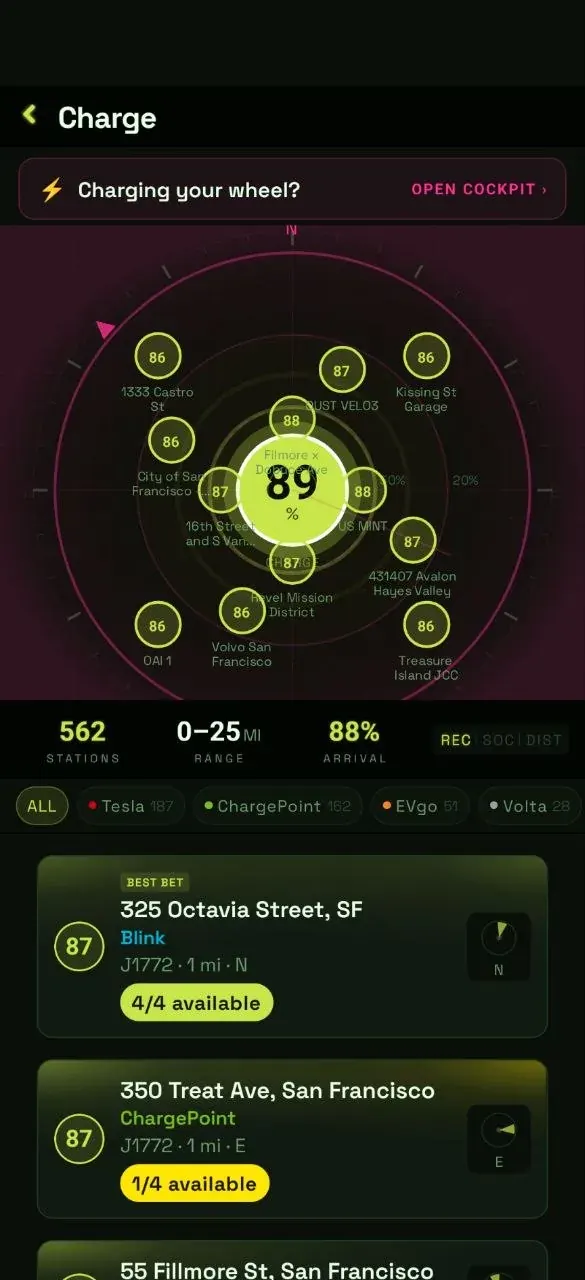
Distance is energy,
not miles.

The centre of the scope is you. Each ping’s radius is how much charge it’ll cost to arrive — terrain, wind and speed baked in — so a charger that’s close but uphill sits farther out than a flat one further away. Ring labels mark the 50% and 20% arrival-battery lines. Unreachable chargers gray out with an ✕.

81%Comfortable — arrive with margin to spare
34%Tight — plan to charge here, not skip it
12%Out of safe reach — find a closer source
4/4Live availability — how many stalls are free right now, not just where they are

When the network thins the scope says so rather than looking healthy: amber when only one or two Level 2 options are in reach, red when none are. At that point it overrides your own filters, surfacing RV and 120V sources so you can see everything there is rather than what you asked for.

Flow charge radar — chargers placed by bearing and arrival battery

Connect the dots
across the landscape.

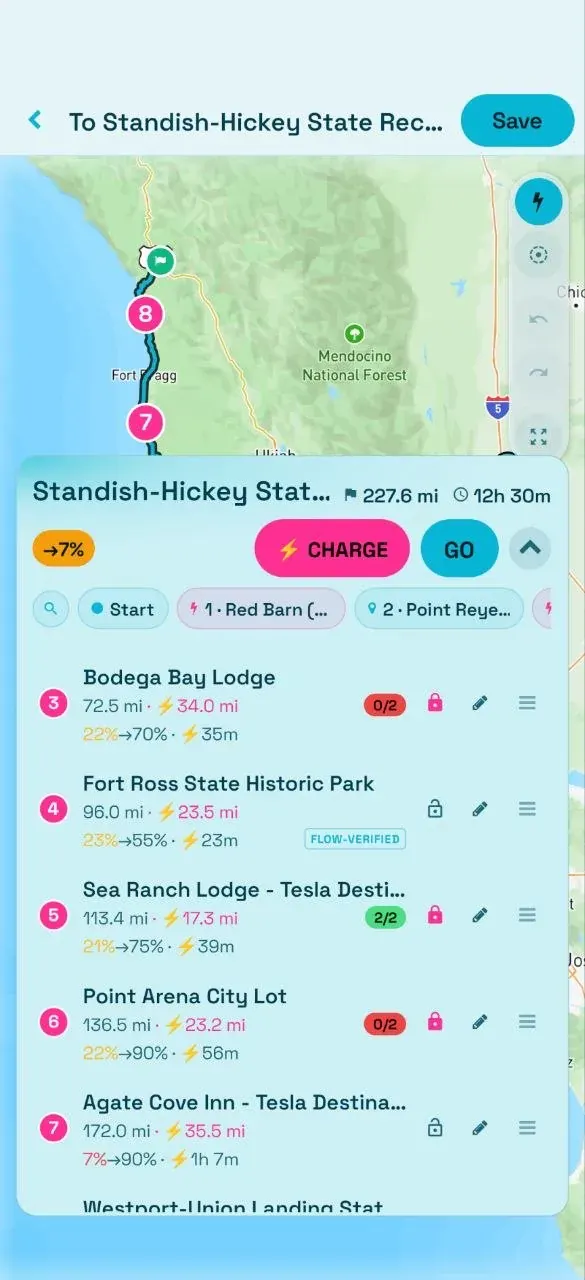
Tap a reachable ping and Flow chains it into your route — a connect-the-dots line of charging stops where viable long-distance riding didn’t exist before.

What works for PEVs: L1 (120V/NEMA 5-15), L2 J1772, Tesla Destination, and RV hookups (NEMA 14-50, TT-30) all work for EUCs, e-scooters, e-bikes, and onewheels. Only L3/DC fast chargers (CCS, CHAdeMO, Supercharger) are incompatible — Flow never routes you to those.
Edit the whole chain Route Studio: arrival battery, departure battery and wait time per stop.
Route Studio — a seven-stop charge chain with arrival and departure battery per stop
Charge

Charging while
you’re there.

Plugged in, the Charge tab asks “Charging your wheel?” and offers Open Cockpit. Entry is always a deliberate tap — Flow never flips into charging mode on its own, so the cockpit can’t lie about what it’s watching. Once open, the ring fills as your battery does, big enough to read across a parking lot.

Two estimates run at once: time to 80% and time to 100%, each with the clock time it lands, because packs charge fast to 80% and then taper. If your wheel reports charge current over Bluetooth, Flow shows live watts; until that reading proves trustworthy it shows a conservative percent-per-hour instead.

  • ✓Tap Open Cockpit — it never starts itself
  • ✓Time to 80% and time to 100%, plus the clock time for each
  • ✓Live watts only once your wheel’s reading has proven itself
  • ✓Keep the phone near the wheel to hold the Bluetooth link
Charge cockpitLIVE

Ninety minutes at an RV hookup is a different ride than ninety minutes guessing. The cockpit turns a wait into a number you can plan the rest of the day around.

Charging right now? The step-by-step, including what to do when watts don’t appear.

Chargers riders fix themselves.

Flow pulls chargers from several public databases, but the best PEV charging knowledge lives with riders — the café that lets you plug in, the campground with an open NEMA 14-50, the J1772 pedestal that turns out to be blocked.

Add what you find

Sign in and submit a charger with its location, type and access notes. It enters a review queue and goes live for everyone once verified.

Track your submissions

Settings, then My Submissions: each one reads pending, verified or rejected, so you know whether the campground you added is on other riders’ maps yet.

Flag what’s wrong

Wrong location, gone, DC-only after all? Flag it. Community-verified chargers are marked in the app, so a station a rider has actually plugged into reads differently from one that only exists in a database.

Corrections that need a record: info@pevra.org
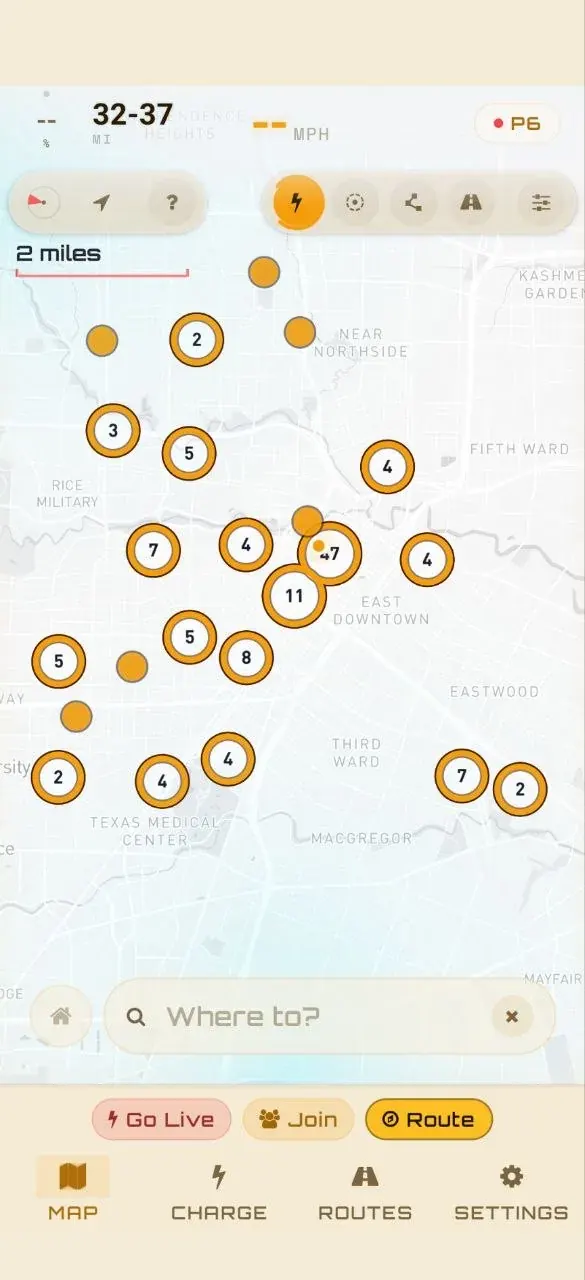
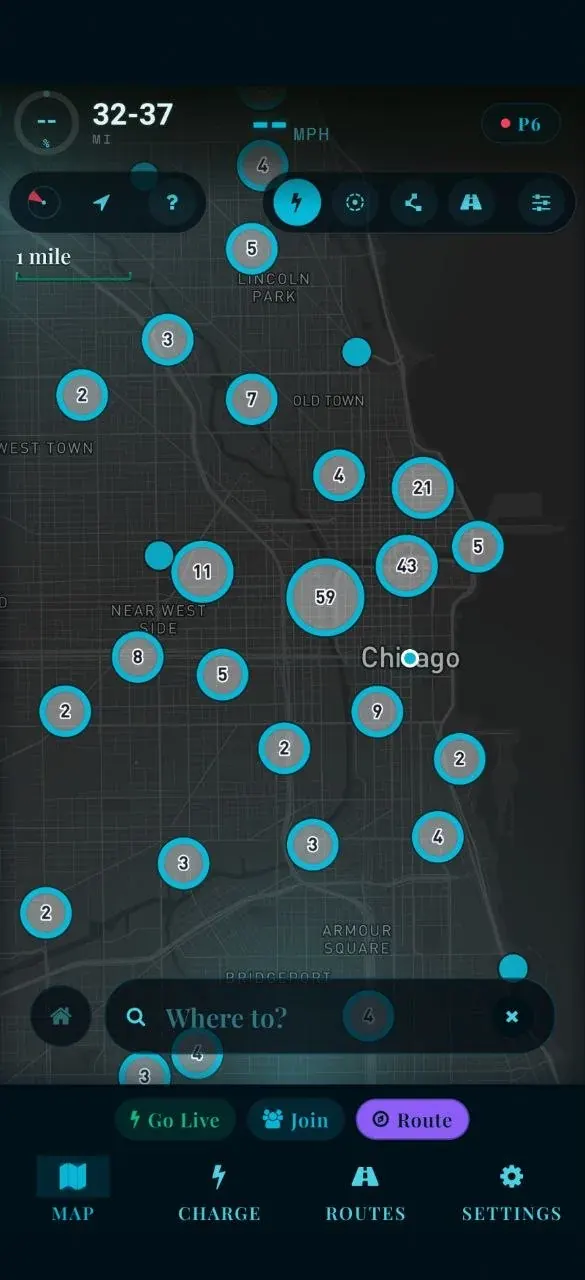
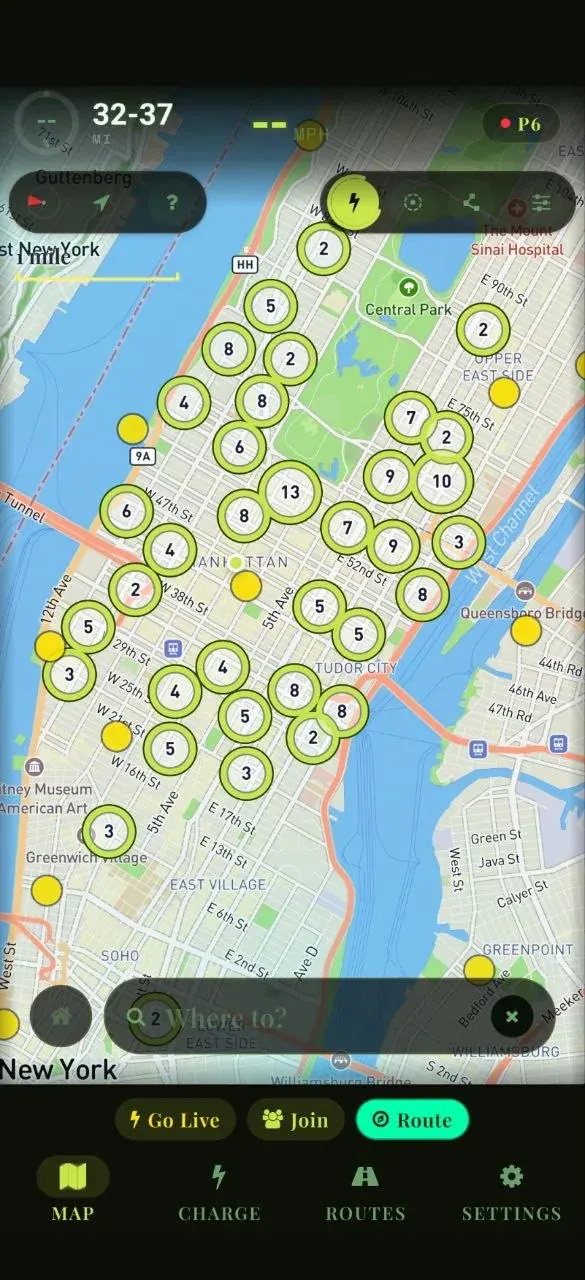
Your charge map, worldwide.

Flow taps charger databases used in more than 27 countries, and finds chargers in all of them. Distances can be shown in miles or kilometers, your choice.

Flow map showing chargers across Houston

Houston

Flow map showing chargers across Chicago

Chicago

Flow map showing chargers across Manhattan

New York

Charge types for PEVs L2+RV+L1
Level 2 chargers mapped 150,000+
Countries with mapped chargers 27+
Stall availability where covered Live

The next charge is already on the map.

Prefer a big screen? Plan on your laptop in the Flow Route Builder, then send the route to your phone. Charging your wheel right now? The charge cockpit tracks it live.